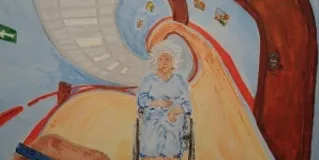
Clinical momentum—increasingly aggressive treatment in intensive care settings that can violate a patient’s wishes—is charged by ritually intensifying efforts to “save” a patient, reimbursement patterns that privilege acute interventions, and technology-driven health care.
AMA J Ethics. 2018;20(8):E732-737. doi:
10.1001/amajethics.2018.732.
Undocumented patients in the United States with end-stage renal disease receive “compassionate” dialysis. Such patients oscillate between being marginally well and “ill enough” to receive dialysis while clinicians wrestle with complicity in a system that both offers and withholds life-saving therapy.
AMA J Ethics. 2018;20(8):E778-779. doi:
10.1001/amajethics.2018.778.
Peter T. Hetzler III and Lydia S. Dugdale, MD, MAR
Countering overmedicalization of death requires acknowledging that dying patients are living patients. It also requires persistent focus on health and wholeness, especially at the end of life, and a solid interdisciplinary approach to supporting dying patients.
AMA J Ethics. 2018;20(8):E766-773. doi:
10.1001/amajethics.2018.766.
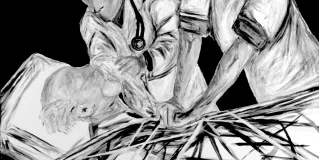
This image depicts a dying elder undergoing cardiopulmonary resuscitation, suggesting consideration of the ethical weight of the invasiveness and force of chest compressions.
AMA J Ethics. 2018;20(8):E774-775. doi:
10.1001/amajethics.2018.774.
Katherine Gentry, MD, MA and Aaron Wightman, MD, MA
A patient’s refusal of tracheostomy during an anticipated difficult intubation prompts critical questions about how to best express respect for a pediatric patient’s autonomy and whether and when deviation from standard of care is clinically and ethically appropriate.
AMA J Ethics. 2018;20(8):E683-689. doi:
10.1001/amajethics.2018.683.
Alexander Craig, MPhil and Elizabeth Dzeng, MD, PhD, MPH
Eliciting the patient’s motives and goals and helping the patient and her loved ones explore alternatives are essential to maintaining trusting relationships and open communication.
AMA J Ethics. 2018;20(8):E690-698. doi:
10.1001/amajethics.2018.690.
Physicians new to a case might object to an established care plan. Practice variation, clinical momentum, and how value is assigned by different parties to acute care and comfort measures can each contribute to conflict in these cases.
AMA J Ethics. 2018;20(8):E699-707. doi:
10.1001/amajethics.2018.699.
The George Washington University has taken the lead in preparing trainees to meet patients’ spiritual needs by integrating spirituality into its curriculum, developing a training program for teaching interprofessional spiritual care, and designing spirituality-related competency behaviors.
AMA J Ethics. 2018;20(7):E655-663. doi:
10.1001/amajethics.2018.655.
In clinical settings, chaplains are key communicators who help mediate between patients, families, and the medical team. This month on Ethics Talk, we explore how chaplains help patients and families articulate their goals and navigate logistical and emotional challenges that arise in the hospital.