Abstract
Visual symbols such as the rod of Asclepius possess rhetorical power by illuminating core values—in the case of medicine, those qualities that make a good physician. Patients expect their physicians to demonstrate skill and judgment, as well as to comfort with compassion and empathy. With the emergence of artificial intelligence, questions abound about how this technology will transform and disrupt the practice of medicine and, ultimately, the therapeutic relationship between physicians and those whom they are committed to serve.
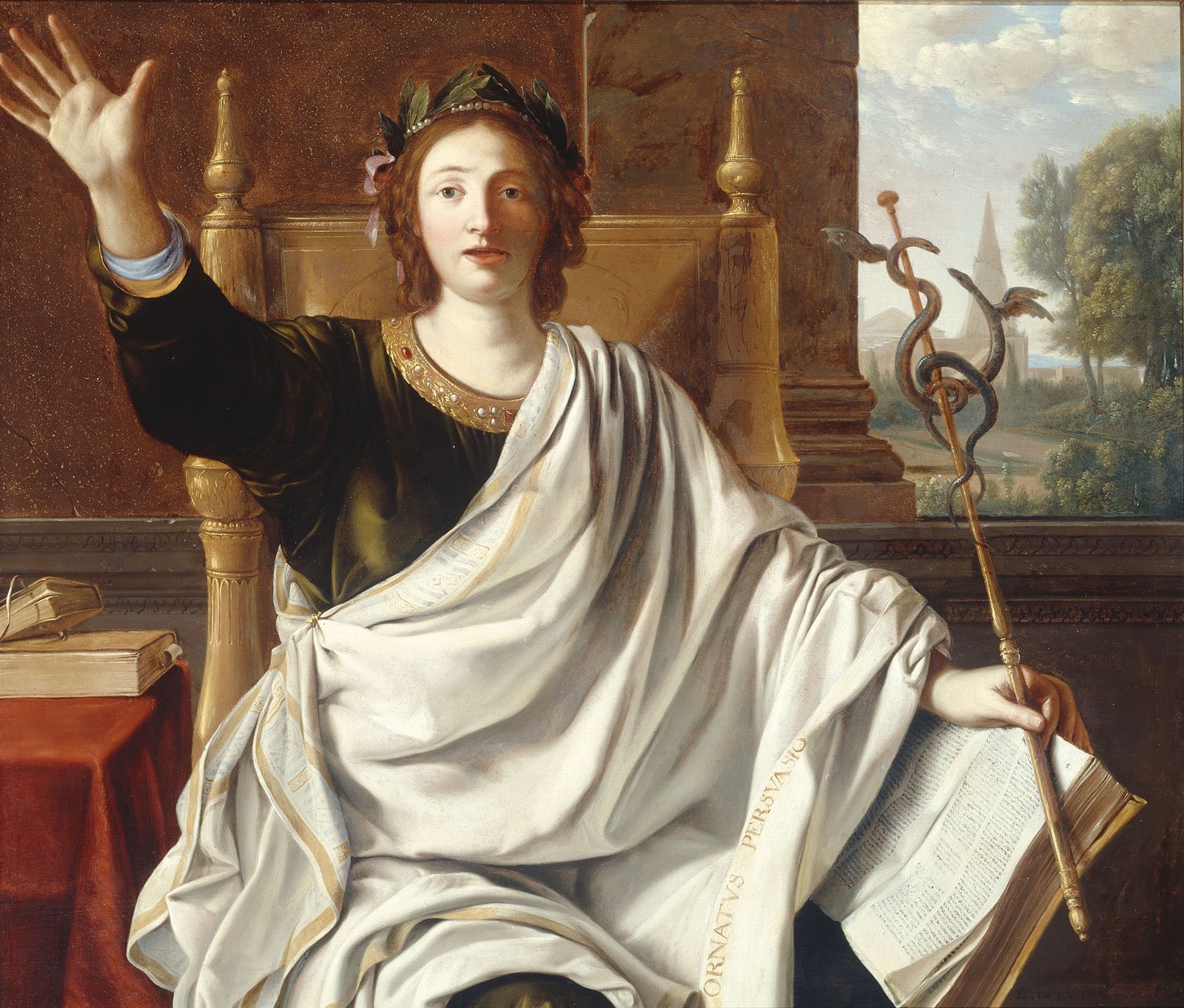
Commissioned for Gédéon Tallemant (1613–1668), an influential administrator in the French court of King Louis XIV, the Allegory of Rhetoric (1650, oil on canvas) was one of 7 paintings representing the liberal arts by Baroque artist Laurent de La Hyre (1606-1656).
In addition to capturing rhetoric, La Hyre painted other female figures embodying grammar, logic, arithmetic, music, geometry, and astronomy, which combined were the foundational elements of classical education in the era of Antiquity.
La Hyre modeled the figures after illustrations in Cesare Ripa’s book, Iconologia, published in 1603.1 Ripa’s work greatly influenced writers and artists employing symbolic imagery to convey complex ideas and moral lessons.
The edge of the figure’s skirt is embroidered with the phrase ornatus persuasio. This phrase generally translates to "decorated with conviction" or "rhetoric is persuasion,” denoting the function and power of rhetoric.
Aristotle (384-322 BCE) saw the art of persuasive power as one’s arguments grounded in 3 areas: ethos, pathos, and logos.2 Ideally, these persuasive appeals are all drawn upon to form what later rhetoricians called the rhetorical triangle.
Ethos, or ethical persuasiveness, refers to a speaker’s or writer’s character when making an argument. Do they possess the authority and credibility to address this topic? Do they seem to be knowledgeable and reasonable? Do they appear to be honorable and trustworthy? Draped in a robe, wearing a garland, and sitting in a throne-like chair, this figure is adorned with authoritative and honorific symbols.
An outstretched arm seemingly gesturing to and reaching out to an audience, pathos, or emotional persuasiveness, appeals to the feelings and imagination of the listener or reader. How does the speaker or writer establish a relationship with the audience? Which emotions are evoked in connecting with the audience? What circumstances can the audience relate to or imagine?
Symbolized by a book propped open by the figure’s left hand, logos, or logical persuasivness, appeals to reason. What facts and evidence have been brought to bear in this tome? Are they relevant to the argument? Do the conclusions make sense?
Along with the revealed book, a staff with 2 winged snakes is pinched upright by the figure’s left thumb. From the 16th to the 19th centuries, such a staff was commonly used as a symbol for rhetoric.3 Over the millenia, this staff, known as the Caduceus, has come to symbolize various human endeavors—including, if mistakenly, the art of doctoring and the medical profession.
Figure 2. Roman fresco from the eastern wall of the triclinium in the Casa dei Vettii ("House of the Vetii", VI 15, 1) in Pompeii, Fourth Style (60-79 CE)

The staff of Caduceus originated with the Greek god Hermes.4 As the patron god of negotiation, trade, and commerce, Hermes was also regarded as the cleverest of the Olympian gods and as a protector of thieves, merchants, and orators, all of whom probably relied on sly actions and clever persuasion in their line of work.
Figure 3. Mercury, 1611, by Hendrik Goltzius

Similarly, the Caduceus represented Hermes’ Roman counterpart, Mercury.
Figure 4. Statue of Asclepius, Exhibited in the Museum of Epidaurus Theatre, circa 4th century BCE

In Greek mythology, a single serpent-entwined staff was wielded by Asclepius, son of Apollo, and a god associated with healing and medicine. The rod of Asclepius has symbolized Western medicine into modern times.5
Despite the symbolic origins of the rod of Asclepius, the 2-serpent staff of Caduceus has been misused to represent medicine for well over a century and probably much longer than that. In 1902, the US Army incorrectly used it for its Medical Corps logo.6
Figure 5. US Army Medical Corps Branch Plaque, 1902

Figure 6. Flag of the US Surgeon General

Are 2 snakes better than one? The US Army Medical Corps logo has never been corrected and likely spawned more mistaken uses over the years, including the current seal and flag of the US Surgeon General. Some claimed that the American Medical Association (AMA) also used the Caduceus in its logo,7 but that logo claim defies logos and evidence.
Founded in 1847, the AMA adopted its first official logo in 1898. Designed by Dr Richard French Stone of Indiana,8 the logo was a circular shield with a spear-pointed cross design symbolizing the protective armor of ancient times. Notable is the acronym MAMA on the perimeter, which stood for member of the American Medical Association.
Figure 7. American Medical Association Logo

In 1903, the AMA logo was modified to incorporate a red cross, which was used by other health-related organizations at the time, including the American Red Cross and the International Anti-Tuberculosis Association, a forerunner of the American Lung Association.
Figure 8. American Medical Association Logo

Figure 9. American Medical Association Logo

In 1910, the rod of Asclepius officially became part of the AMA logo. The Committee on Insignia stated that “the true ancestral symbol of the healing art is the knotty pine and the serpent of Aesculapius.”9 Scarlet and gold were chosen as the primary logo colors, given their association with medicine dating back to ancient Greece. Some committee members wanted to include an eagle, but that idea was not adopted.10
Refinements to the AMA logo were approved in 1953.
Figure 10. American Medical Association Logo

Figure 11. American Medical Association Logo

The logo was refined again in 1966.
It underwent another change in 1991.
Figure 12. American Medical Association Logo, 1991

Figure 13. American Medical Association Logo

In 2005, the AMA’s logo was modernized and remains its logo today. The then-AMA chief executive officer remarked that “the more modern visual of the staff of Aesculapius captures the proactive and aggressive role the AMA will play on behalf of our physician members. The purple color connotes unity and balance, and communicates science, creativity and tradition.”11
With its various logo incarnations over the years, the symbolic integrity of the AMA logo ultimately rests on the AMA’s organizational actions and their moral proximity to the ideals of medicine. Should the AMA stray too far or too long from these ideals,12 its appropriation of the Asclepian rod would be false and misleading advertising.
As artistic shorthand for moral ideals, visual symbols possess potency by illuminating core values—in the case of medicine, those qualities that make a good physician. In seeking medical care, patients expect their physicians to demonstrate competence and judgment, as well as to comfort with compassion and empathy in service to the sick and injured.
Thus, it should be alarming that the Caduceus has been used by some to represent the medical profession, inadvertently perpetuating the practice of medicine as more a business than a calling and its practitioners as merchants providing a commodity like any other in an economy.
Figure 14. Gold Medical Serpent Symbol Rod of Asclepius

Figure 15. Power Loom Weaving

During the Industrial Revolution in the 18th and 19th centuries, mechanical inventions like the power loom transformed the nature of business, commerce, and production-oriented work. In this century, intelligent machines such as artificial intelligence (AI) technologies are again poised to fuel workplace transformations and labor market disruptions,13 provoking concerns and questions about their impact on knowledge-centered work like medicine.
For example, will AI evolve to support patient-centered expectations and physician professionalism? While AI can aid physicians in their work, could physicians be supplanted by AI?14 What does it mean to be a good physician in the age of AI?
Rhetorically arguing for a health care system in which physician colleagues could never be replaced by AI would be self-serving. Whether being up-front about this protective bias enhances my ethos, it’s important to acknowledge that while AI can perform some medical tasks as well as or better than physicians,15,16 the benefits of AI should be focused on how to augment the efficiency and quality of physician work.
Given that AI developers often cannot fully understand how their own AI tools15,16 arrive at their outputs,17 entrusting such “black box” technologies to wholly replace physicians’ skills and judgment would not be in society’s enlightened self-interest. Thus, health care AI demands human oversight and accountability.18,19
Figure 16. Detail of head, Allegory of Rhetoric

Figure 17. Detail of hand, Allegory of Rhetoric

It may be hard to accept that some patients consider encounters with an AI chatbot to be more satisfying than those they have with a physician. Studies have found that patients feel chatbot responses to be more empathetic than those provided by health care professionals.20 But it’s one thing for an AI chatbot to deliver a persuasive moment of empathy and something completely different for a patient to initiate and sustain a therapeutic relationship with a human physician.
In the United States, uninsured and underserved patient populations are usually groups that have little or delayed access to the newest health care technologies and innovations.21 Thus, it would be ironic if historically marginalized patients have no option but to settle for an AI chatbot without access to a physician.
Figure 18. Detail of Caduceus, Allegory of Rhetoric

While evidence grows on how AI can help physicians be better diagnosticians,22,23 there is also emerging data suggesting that use of AI can result in physicians losing their clinical skills (deskilling), trusting and defaulting to AI with its attendant errors and biases (mis-skilling), or never acquiring fundamental skills of doctoring (never-skilling).24,25
Educational strategies for enabling physicians to acquire and maintain the skills and competencies that they need to be good physicians are critical if we expect to rely on human oversight of and accountability for AI use in health care.26
Figure 19. Image from “Abolitionist Reimaginings of Health”

On November 30, 2022, AI exploded into public consciousness with ChatGPT. AI has sparked feverish optimism at the prospects of tackling long-standing ills in our health care system such as wasteful spending and medical errors.27 Whether these benefits of AI are realized without serious harms will require fidelity to the core values of the medical profession and what it means to be a good physician.
References
-
Ripa C. Nova Iconologia. Woodcut. Pietro Paulo Tozzi; 1618. The Met. Accessed December 8, 2025. https://www.metmuseum.org/art/collection/search/370219
-
Rapp C. Aristotle’s rhetoric. Stanford Encyclopedia of Philosophy. May 2, 2002. Revised March 15, 2022. Accessed December 8, 2025. https://plato.stanford.edu/entries/aristotle-rhetoric/
-
Noldus B, Roding J, eds. Pieter Isaacsz (1569-1625): Court Painter, Art Trader and Spy. Brepols; 2007.
-
Cartwright M. Hermes: the messenger of the Olympian gods. World History Encyclopedia®. August 28, 2019. Accessed December 8, 2025. https://www.worldhistory.org/Hermes/
- Wilcox RA, Whitham EM. The symbol of modern medicine: why one snake is more than two. Ann Intern Med. 2003;138(8):673-677.
- Prakash M, Johnny JC. Things you don’t learn in medical school: Caduceus. J Pharm Bioallied Sci. 2015;7(suppl 1):549-550.
- Engle BS. The use of Mercury's Caduceus as a medical emblem. Class J. 1929;25(3):204-208.
-
House of Delegates. Association news. In: Proceedings of the American Medical Association House of Delegates. American Medical Association; 1898:82-94. Accessed December 8, 2025. https://ama.nmtvault.com/jsp/PsImageViewer.jsp?doc_id=1ee24daa-2768-4bff-b792-e4859988fe94%2Fama_arch%2FHOD00003%2F00000016&pg_seq=8
-
House of Delegates. Report of the Committee on Insignia. In: Proceedings of the American Medical Association House of Delegates. American Medical Association; 1910:34. https://ama.nmtvault.com/jsp/PsImageViewer.jsp?doc_id=1ee24daa-2768-4bff-b792-e4859988fe94%2Fama_arch%2FHOD00001%2F00000001
-
House of Delegates. A new badge. In: Proceedings of the American Medical Association House of Delegates. American Medical Association; 1947:265. https://ama.nmtvault.com/jsp/PsImageViewer.jsp?doc_id=e7b3b08e-5d2a-40d6-ac45-b8b6ada9325f%2Fama_arch%2FAD000001%2F0038HIST&pg_seq=281
-
House of Delegates. Address of the executive vice president. In: Proceedings of the American Medical Association House of Delegates. American Medical Association; 2005:8-10. https://ama.nmtvault.com/jsp/PsImageViewer.jsp?doc_id=1ee24daa-2768-4bff-b792-e4859988fe94%2Fama_arch%2FHOD00004%2F00000006&pg_seq=9
- Baker R, Wynia MK. Living histories of structural racism and organized medicine. AMA J Ethics. 2021;23(12):E995-E1003.
-
Sigalos M. MIT study finds AI can already replace 11.7% of US workforce. CNBC. November 26, 2025. Accessed December 8, 2025. https://www.cnbc.com/2025/11/26/mit-study-finds-ai-can-already-replace-11point7percent-of-us-workforce.html
-
Rosenbluth T, Astor M. Empathetic, available, cheap: when AI offers what doctors don’t. New York Times. November 17. 2025. Accessed December 8, 2025. https://www.nytimes.com/2025/11/16/well/ai-chatbot-doctors-health-care-advice.html
-
Yoon JH, Strand F, Baltzer PAT, et al. Standalone AI for breast cancer detection at screening digital mammography and digital breast tomosynthesis: a systematic review and meta-analysis. Radiology. 2023;307(5):e222639.
-
Jaeckle F, Denholm J, Schreiber B, et al. Machine learning achieves pathologist-level coeliac disease diagnosis. NEJM AI. 2025;2(4):aioa2400738.
-
Blouin L. AI’s mysterious “black box” problem, explained. University of Michigan-Dearborn News. March 6, 2023. Accessed December 8, 2025. https://umdearborn.edu/news/ais-mysterious-black-box-problem-explained
- Habli I, Lawton T, Porter Z. Artificial intelligence in health care: accountability and safety. Bull World Health Organ. 2020;98(4):251-256.
-
Justice B. To implement health AI, first decide who’s accountable. AMA Newswire. July 24, 2025. Accessed December 8, 2025. https://www.ama-assn.org/practice-management/digital-health/implement-health-ai-first-decide-who-s-accountable
-
Howcroft A, Bennett-Weston A, Khan A, Griffiths J, Gay S, Howick J. AI chatbots versus human healthcare professionals: a systematic review and meta-analysis of empathy in patient care, Brit Med Bull. 2025;156(1): ldaf017.
-
Weiss D, Rydland HT, Øversveen E, Jensen MR, Solhaug S, Krokstad S. Innovative technologies and social inequalities in health: a scoping review of the literature. PLoS One. 2018;13(4):e0195447.
- Taylor RA, Sangal RB, Smith ME, et al. Leveraging artificial intelligence to reduce diagnostic errors in emergency medicine: challenges, opportunities, and future directions. Acad Emerg Med. 2024;32(3):327-339.
-
Soliman A, Li Z, Parwani AV. Artificial intelligence's impact on breast cancer pathology: a literature review. Diagn Pathol. 2024;19(1):38.
-
Berzin TM, Topol EJ. Preserving clinical skills in the age of AI assistance. Lancet. 2025;406(10513):1719.
-
Rosenbluth T. Are AI tools making doctors worse at their jobs? New York Times. August 29, 2025. Accessed December 8, 2025. https://www.nytimes.com/2025/08/28/well/ai-making-doctors-worse-deskilling.html
- Abdulnour RE, Gin B, Boscardin CK. Educational strategies for clinical supervision of artificial intelligence use. N Engl J Med. 2025;393(8):786-797.
-
Wachter RM, Brynjolfsson E. Will generative artificial intelligence deliver on its promise in health care? JAMA. 2024;331(1):65-69.